

As the game progressed into the second half, Fellaini slapped his head several times in a row and yelled at his teammates. Why?
This round of the Chinese Super League was the first to feature a battle between the two traditional giants, Beijing Guoan and Shandong Taishan. Due to their poor performance in the first three rounds, both teams can't afford to lose this game. In addition, the feud between the two teams has always been very deep, so the matchup is full of expectations from the outside world.
But throughout the game, until the last minute, neither side scored a single goal, and the game ended in a 0:0 draw.
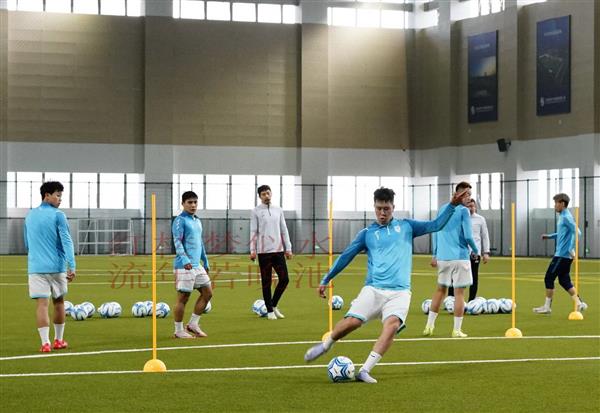
Throughout the match, Shandong Taishan, despite playing away from home, had significantly more chances to threaten the ball than Beijing Guoan. And several times they were only close to breaking through, such as Sun Guowen hitting the crossbar, Fellaini's sledgehammer and so on. Unfortunately, I didn't reward the match effort with a goal.
There was a definite dominance of the scenario and a dominant number of threatening balls in front of the penalty area. Why are the results not as good as they could be? The root cause is the sideways passing!
In this game, Shandong Taishan's tactic of choice remains an overhead kick. That is to say, creating opportunities for the wingers to form passing chances through sustained cooperation to create scoring chances for Fellaini in the box.
As a result, the burden fell on several wingers. Sun Guowen and Liu Binbin, who started the match, were the first echelon. Later Liu Yang and substitute Chen Pu formed the second echelon, taking turns passing to the box.
These players, undoubtedly at international level, are essentially the hot internationals of the current campaign. But the end result, why can't they match their ability?
Throughout the game, these four internationals made nearly 20 crosses. With the exception of a header from Liu Binbin late in the first half, which posed some threat to Fellaini, the current state of the crosses was terrible. Passes bottomed out, floated high, slow, blocked by defenders, too much or too little power, etc.
In the second half, Shandong Taishan once completely suppressed Beijing Guoan. As long as the side can make a few decent passes, it's not hard to break through. But I never waited for reliable feet, which explains why Fellaini was in such a hurry! Every time a cross came over, it was always so far wide of him that he wasn't a threat at all, and the rest of his teammates didn't have the height advantage. So, seeing his team dominate but not threaten, Fellaini was particularly impatient and kept reminding his teammates to upload onto his head.
Each of the four wingbacks has their own characteristics, but their shortcomings are also obvious. Newcomer Sun Guowen has worked hard and performed well in the first few rounds, but hasn't particularly excelled at breaking and passing. Liu Binbin is difficult to shoot at except for his speed, and will only go to the end line when he gets the ball, and is ordinary in terms of changes of pace and chances after internal cuts, as well as shooting. Liu Yang's primary assignment is as a wingback. While he is talented on offense, he either loses or makes mistakes.
The passing threat was high at the time. In addition to having good high centers in the middle, the reliability of the two side passes was also a major reason. Unfortunately, Wu Xinghan and Jin Jingdao were two good wingbacks back then.
For Beijing Guoan, the game was a result of an average Taishan performance that made Guoan's goal very dangerous whenever there were a few decent crosses. Even when Taishan were so frustrated, Guoan almost failed.
Finally, we still need to mention more about Shandong Taishan's tactics. In this game, the return of Kressan brought new energy and ideas to the team's offensive line. The reason why the team played so well last season depended a lot on the tacit cooperation between Klassen and Moises. Now that Kressan is back, should the team return to a familiar routine.
But judging by this game, Fabio doesn't seem to want to do that. He still wants Fellaini to stand up front and look for a tactical change by utilizing a high ball. Cressan stood behind Fellaini, creating a free man on the attacking line. In this case, even if Fellaini is not a threat from the first point, Kressan can use his nimble footwork to form another chance from the second point. Just as Pelle tops the box, Tardelli is active behind him as a shadow winger.
But this is just a theoretical idea, once Cressan retreats, he will overlap with Moises in the front position, and their positions will definitely affect the organization and scoring in the middle. In addition, the unreliable side passes we mentioned above could easily lead to an awkward situation where the side attacks don't go well and the organization in the middle loses its former dynamism. Thus, for Fabio, the return of Kressan must be weighed against the tactical options of whether Fellaini will remain up front.