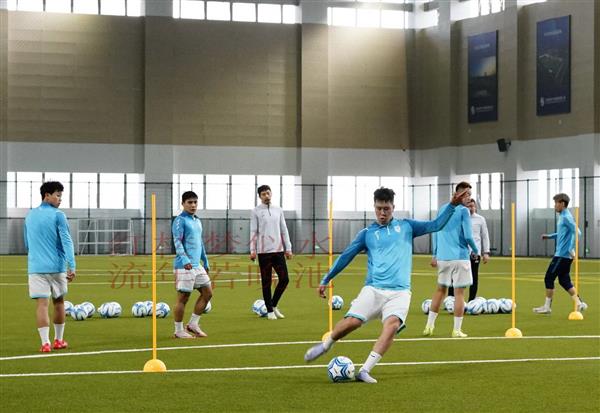

Qingdao Manatee Football Club was founded in December 1993 and is the first professional soccer team in Qingdao.
In early 2005, Qingdao Zhongneng Group joined Qingdao Hainiu. At that time, Dalian Shide, Wuhan Tianlong Huanghelou, Shanghai International, Sichuan Guancheng, Liaoning Zhonglong Huanghelou, Shanghai International, Sichuan Guancheng, and Liaoning Zhong clubs withdrew, disbanded or merged.
In 2013, the Qingdao Manatees were eventually relegated from the Chinese Super League due to insufficient funds to support Jinyuan Football. At the time, of the 16 CSL clubs, Guizhou Renhe, Shanghai Shenxin, Liaoning Hongyuan and Jiangsu Shuntian had either quit or dissolved. Of the 12 clubs still in existence at the time, then-champions Guangzhou Evergrande, Guangzhou R&F and then-last-place Wuhan Zhuoer, the CSL is trying to avoid relegation this season.
When the Qingdao Sea Cowboys were relegated from China's First Division in 2016, four of the then 16 Chinese Super League clubs had already quit or disbanded: runners-up Jiangsu Suning, Chongqing Lifan, Yanbian Fude and Liaoning Hongyuan. Then-champions Guangzhou Evergrande and sixth-placed Guangzhou R&F are currently in the relegation loop. At the time, Hebei Huaxia Happiness' seventh-place finish was confirmed to be relegated. At the time, nine of the 16 teams in China's First Division bid farewell to the professional league, including Tianjin Quanjian, Guizhou Hengfeng, Qingdao Yellow Sea and Beijing Renhe.
Qingdao Hainiu has been standing in the league for 18 years and Chinese soccer has been professionalized for 29 years after Zhongneng Group's ownership. Qingdao Hainiu is one of the few teams that have been standing in the professional league. 1994 saw the inaugural Chinese professional league kick off, including A and AB, and now there are only Guangzhou, Shanghai Shenhua, Shandong Taishan, Beijing Guoan, Qingdao Hainiu, Tianjin Golden Gate Tigers, Henan Jianye, and after constant migration, there are now a total of eight teams in Guangzhou City (ex-FuLi). In terms of investment in the last decade, these eight clubs have four giants, three upstream clubs, and only the small and medium-sized clubs of Qingdao Hainiu.
Qingdao Hainiu played in the top league for 18 years. In the era of gold dollar soccer, Qingdao Hainiu, as a small and medium-sized club, was relegated from the Chinese Super League to the Central League A under economic pressure, and from the Central League A to the Central League B in 2016.
Perhaps, many people thought that Qingdao Manatee would "disappear" here and would not survive, but Qingdao Manatee tenaciously survived and returned to the order of the top league step by step. After years of persistence and exploration, the club has found a set of healthy methods suitable for itself, which is reflected in several aspects: firstly, reasonable investment according to its own situation, which can guarantee the payment of wages; secondly, always insisting on youth training, Qingdao Manatee always participates in the U series league, Youth Super League and China Youth Football League, sometimes even the only one, both in A and B in China. This season, Qingdao Hainiu U19 won the seventh place in the China Youth Football League, and U21 advanced to the last eight of the U21 League.
Qingdao Hainiu has become a model for small and medium-sized clubs in the Chinese professional league. If Chinese professional soccer clubs could realize the stable development of Qingdao Hainiu, the Chinese professional league would not be in a passive state at present. Looking ahead, it must be said that Qingdao Hainiu, as a small and medium-sized club, does not have a strong ability to weather the storm in terms of how to survive in the top league. How to provide appropriate support in Qingdao to improve its ability to weather the storm is a topic of concern.
The ups and downs of Qingdao's soccer in the professional leagues are somewhat related to Qingdao's lack of substantial support for professional clubs. Over the years, most of the support has been verbal and planning, and there has been a lack of substantial support and investment. Currently, Qingdao soccer has a top-tier club in Qingdao Hainiu, a Chinese a club in Qingdao, a Chinese B club in Qingdao Red Lion, and third-tier league teams. There is a need for master planning and substantial support. The development of professional soccer clubs cannot rely on government blood transfusion, but overall planning and reasonable and substantial support can gather people's hearts, increase resistance and promote development. This is a responsibility that Qingdao Soccer City should not avoid, as well as Qingdao's 13th place in the GDP city grid.