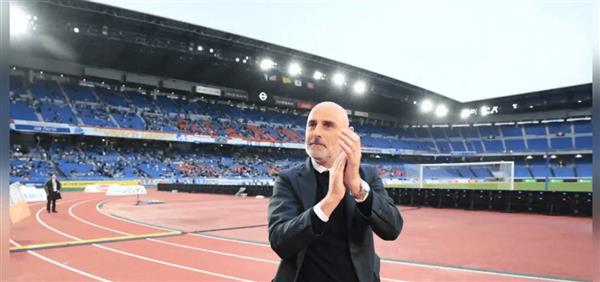


In an interview with Nikkan Sports on October 6, Takeshi Okada, vice president of the Japan Football Association (JFA), fondly recalled his coaching career in China. 2011 to 2013, Takeshi Okada served as the head coach of Chinese Super League team Hangzhou Greentown (now Zhejiang), and left the post due to family reasons, but the two sides have maintained a cooperative relationship in terms of youth training.
Below are excerpts from an interview with Takeshi Okada:
I am a person who likes to take on new challenges, and choosing to coach in China suited my personality. At that time, I had led Japan to the World Cup finals twice and won the J-League twice. The opportunity to coach in China came just as I was thinking about what to do next. I came to China not to promote Japanese soccer, but because I found the challenge fresh and interesting. My knowledge of China gave me the will to experience it for myself.
I remember that in the fall of 2011, Cai Zhenhua, Vice Director of the General Administration of Sport of China, led a delegation on a visit to Japan, and I received them as a representative of the Japanese side. Cai Zhenhua asked me if I was interested in coaching in China, and I replied in the affirmative on the spot. Afterwards, the delegation emailed the relevant information to the clubs, and a total of six Super League and First Division clubs were interested in inviting me, but in the end, only Hangzhou Greentown formally extended an invitation. When I received the invitation, I drew a blueprint in my mind: I hope to make more friends through soccer, cross borders and cultural differences, and contribute to both countries.
In the end, I decided to accept the invitation to coach in China. In a country with more than 50 nationalities and a predominantly "people-oriented society," I still adhered to the same principle I had when I was coaching the Japanese national team: "No decisions are made for personal reasons, only to lead the team to victory." However, I have made some adjustments to this principle in order to adapt to the customs and social conditions in China. In addition, Kazuo Inamori (deceased), a well-known Japanese industrialist, once advised me, "What you coach in Japan, you can continue to use here."
When I was coaching at Hangzhou Greentown, I followed the same coaching style as I did in Japan and told the players, "I trust you and will treat you like Japanese players." The Chinese coaching staff was a bit critical of this: "Even if you trust the Chinese players..." But I still chose to trust the players. For me, one mistake is not terrible, but I will never allow the same mistake to happen again. I remember one time when we arrived at the hotel before an away game, but almost all the players went out privately.
When I was coaching Greentown, some of the players were released by me for violating my team rules twice, and those who relied on relationships to get to the top were also shunned by me. Previously, the team's senior management had tried to interfere with my hiring decisions, and I had once held the idea of resignation to maneuver with them. At that time, I have no personal selfishness, I just want to make Greentown a winning team.
Looking back, the journey of coaching in China was not an easy one. I did my best to do part of the job during those two years, although I was prepared to suffer from the beginning. Even though coaching in China was difficult, the experience was definitely worth it.