

With International Women's Day approaching for another year, we sat down with three Shanghai-based players from the recently crowned Chinese women's soccer team at the Asian Cup for an in-depth conversation on women's issues.
"The unfinished business is the dream."
How do you feel about the fact that your social activities have been almost non-stop in the days since you were released from quarantine? How did you cope with the sudden attention you received after the women's soccer championship?
Li Jiayue:
It's been a very busy time indeed. In addition to interviews, I've been back to my alma mater, cheering on kids who love soccer and sharing my experiences. It was exhausting, but it was worth it. I hope to use the opportunity of winning the Asian Cup to do more positive publicity for women's soccer and attract more people to participate in this sport.
Lena Zhao:
Hardly any time off, but instead busier than on the team. I have been doing various interviews and photo shoots, attending charity dinners, and encouraging women to break the limitations and join the sport. I think these activities are full of positive energy and I enjoy participating in them. I hope that through my efforts, more people will realize that soccer is not exclusively for men, and that women's bravery, self-confidence and sunshine on the pitch are equally fascinating.
q China's women's soccer team's win at the Asian Cup sparked a frenzy among domestic fans. What impact do you hope this victory will have on the long-term development of women's soccer?
Lena Zhao:
After winning the championship, my fan base spiked, which surprised me. I put a lot of effort into making short videos, hoping to be a bridge between the women's soccer team and the fans, so that the outside world can learn more about our coaches and athletes.
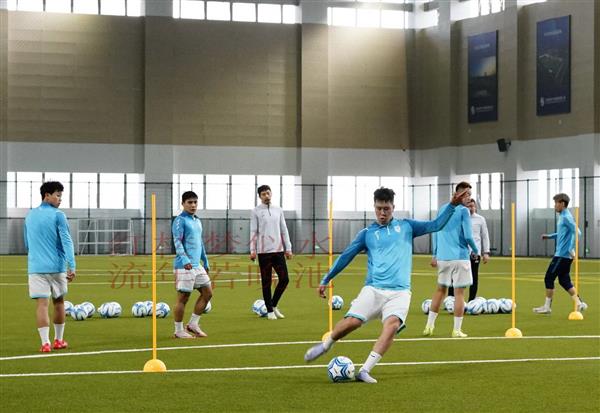
Lena Zhao teaches the technique of driving a big ball in the air in the video
I would have expected to see this earlier (referring to the large number of fans following women's soccer), but until then, women's soccer has had a low level of attention, a fluctuation usually associated with big games. Prior to the championship, the attention to women's soccer was more passive, with not many people actively learning about it. I hope that by winning this championship, people's attention will continue and give us more encouragement and support, and accept our different personalities.
Lena Yang:
I remember in 2016, the Shanghai women's soccer team's attendance at Hongkou Stadium topped out at around 5,000. At that time, we felt it was a blessing to have the support of our fans. In contrast, before that, at the university's home stadium, the attendance for games was often only one or two hundred. Over time, the attention for women's soccer has grown, and before the epidemic, home crowds could reach about 2,000. I'm looking forward to more crowds coming out to cheer us on when the league reverts to a home-and-away system. I hope that people will not just pay attention to us because of one championship, but will continue to care and support us.
Li Jiayue:
While external attention is important, we ourselves have to work hard and improve our strength. The only way to keep the constant attention is to keep producing good results. For me, my dream is to win the Asian Games gold medal, participate in the World Cup and reach the quarterfinals. As the saying goes, "A dream, is called a dream because it is not accomplished."
In this society, both men and women face "age phobia", as professional players, your career is relatively short, do you worry about it? As professional players, you have a relatively short career, do you worry about this? After you retire, will you be limited by your age?
Li Jiayue:
I'm about to turn 32, but so what? I still harbor dreams of higher achievements. I'm not worried about age; many of the seniors in the team have retired at a young age, which is really sad. For me, as long as I can still play and want to play, I will keep going.
Lena Zhao:
When I was young, I always set a lot of limits for myself, such as retiring when I was a few years old and getting married and having children when I was a few years old. But as I get older, I find it harder and harder to let go of my love for soccer. I feel very empty without training and matches these days. I think that since I chose soccer, I was destined to face different eyes. So why not break all the limitations?
Some conventional wisdom might suggest that women who play soccer don't look like women, do you guys feel like women?
Li Jiayue:
Maybe not like a woman in the traditional sense, but I consider myself very much a woman. In this day and age, no one says that women have to have long hair and pale skin to be perfect. Aren't confident, sunny, healthy women beautiful? I think any woman who is good enough and confident is a beautiful woman.
Lena Yang:
I played soccer with the boys when I was a kid and didn't join the women's soccer team until I was in fourth grade. Before that, I never realized I was a girl because there was no sense of gender distinction. Later on, Director Qian got me on the girls' team and I started living in school, and that's when I gradually realized I was a girl.
Lena Zhao:
I've always known I was a girl, and my personality and hobbies skew female. I'm not as masculine as I should be, I'm actually quite gentle and just taller.
Compared to ordinary women, you lack opportunities to study and work with men. Does this lead to a lack of understanding of men, which leads to confusion and uncertainty about how to get along with men?
Lena Yang:
During my elementary and middle school years, Director Qian often had our girls' soccer team exchange games with the boys' team, and we almost never lost. For a long time, I felt like I had a competitive relationship with the boys, but maybe because of that, I felt more like a brother with the boys.
Li Jiayue:
Although I lacked the experience of studying and working with men, I have many male friends and even feel that I may communicate with them better than the average woman because our personalities are more similar.
Your upbringing may have made you realize your femininity later in life, when did you realize that you were a girl and also felt soft, hurt, and in need of love and protection?
Lena Yang:
For those of us who play soccer, physical injuries have long been taken for granted. I remember the earliest time I was training on a yellow sand field, I fell and my skin split open and the sand was embedded in my flesh. My mom cried with heartache when she saw it, and I was unmoved. After I became a professional player, I suffered head injuries during matches, seven stitches in my eyebrow bone and a broken nose, but I never said a word.
In 2013, my grandfather passed away. He had always encouraged me to play soccer and wanted me to be the pride of my family. His passing was a big blow to me, plus when I came back from the National Youth Football League, the coach was changed after the Shanghai National Games and the old players came back to the team, I had very few chances to play. I was in a bad state of mind at the time, but I have always had a strong character and would not let others see my vulnerable side. I wanted to retire for a while, but then Director Shui came on the team and gave me a lot of game opportunities, which rekindled my passion for soccer.
Li Jiayue:
Regardless of profession, regardless of gender, everyone has moments of vulnerability and needs comfort. It has nothing to do with the profession you are in or even the gender. I've encountered a lot of such situations on the soccer field, like the 2015 World Cup, where I was a starter, but when I arrived on the field, I became a substitute and didn't play a minute. I really couldn't accept it at that time, and the comfort of others can only play the role of emotional relief, but ultimately we have to rely on ourselves to come out.
Lena Zhao:
I have long been a person who will not show himself in front of people, even to watch a movie, if the person sitting next to me is not familiar with, to see the moving place will be forced to hold back tears. When I am aggrieved again, I will keep my defense in front of people, and only when I am alone will I secretly shed tears. But as I grew older, I realized that shedding tears became a natural thing, crying when I wanted to, not waiting until I was alone to cry out. "It's okay, you can let yourself be seen shedding tears" is a valuable discovery that age has brought me.
What do you guys think is the most accented thing you've done since you were kids?
Li Jiayue:
Chose to play soccer for this thing.
Lena Zhao:
The moment you stand in front of the goal in your national team's uniform.
Lena Yang:
I remember the moment I stood in the sun that day after buying my family's house, completing the paperwork, and walking out of the real estate transaction center, feeling so sure of my existence. It was one of the things I was most proud of.
Source: News Morning News Weekly App Reporter - Shen Kun Yu
Photo credit: courtesy of the interviewee