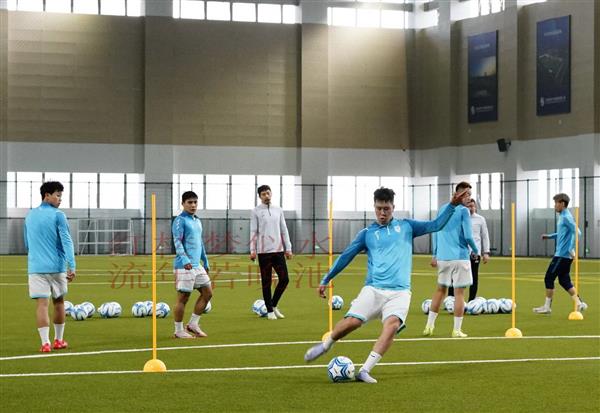


The latest development reveals that Guangzhou Football Club has once again postponed the date of team assembly, which is not the first time. The future direction of Guangzhou soccer has undoubtedly become the focus of hot discussion among fans. The general view is that the Guangzhou club is not to collapse, but whether Evergrande Group continues to invest in soccer is full of variables, and the direction of Guangzhou soccer, is still a question mark.
It is worth noting that this is not the predicament of a single club. Evergrande is facing a crisis, the severity of which lies in that, although related to the enterprise's own situation, but also related to the overall downturn in the real estate industry, the industry crisis brought about by the impact of far more than Evergrande itself, in other words, Evergrande's crisis is not only the crisis of Guangzhou soccer, and may even trigger a wider range of chain reactions, such as real estate investors to withdraw from the Chinese soccer in a large number of Chinese soccer, resulting in the full-scale crisis of the Chinese soccer.
Necessary interventions are particularly important, and more importantly, a more solid foundation for the development of professional soccer clubs in China through the introduction of clearer policies.
Chinese Super League club investors (real estate companies) face a crisis, the focus naturally falls on Evergrande, but for Chinese soccer, Evergrande's crisis is just the tip of the iceberg, most of the real estate companies invested in soccer clubs have appeared serious or relatively serious crisis.
As we all know, Evergrande led the crazy "Golden Dollar Era" of Chinese soccer, winning the Chinese Super League title for seven consecutive years, as well as the AFC Champions League in the 2013 and 2015 seasons. In the past ten years, they have won eight CSL titles and two AFC Champions League titles.
Evergrande's investment in soccer was once extremely successful, Evergrande Group also grew rapidly during this period, the demonstration effect of Evergrande attracted more real estate enterprises to enter the Chinese soccer, the Chinese professional league comprehensively entered the "real estate league era".
There are now a whopping 10 real estate-led clubs among the 16 clubs in the Chinese Super League, including Guangzhou (Evergrande), Guangzhou City (Fuli), Shenzhen (Jiazhaoye), Shenhua (Greenland), Guoan (Zhonghe), Dalianjin (Wanda), Wuhan (Zall), Hebei (Huaxia Happiness), Henan (Jianye), and Cangzhou Lions (Yongchang).
In addition, Shandong Taishan and Changchun Yatai's investors are also partly involved in real estate. The remaining four clubs, Chongqing Liangjiang Athletic and Qingdao, are facing serious difficulties. The former's diversification reform program has been moving forward slowly, while the latter is in dire need of diversification reforms, and the existing investors are no longer sufficient to support the normal operation of the Chinese Super League, and as for Tianjin Jinmen Tigers, it is currently in a custodial status.
Looking at the 10 real estate soccer clubs, we know very well the situation of the Guangzhou team and its investor Evergrande Group, and the situation of the Hebei team and its investor Huaxia Happiness has been reported many times before, in which Huaxia Happiness suffered even greater difficulties than Evergrande, and after the establishment of the Huaxia Happiness Debt Committee in March this year, the club could no longer get support from the Group, and was forced to sell players to survive.
Among the current Chinese Super League club real estate corporate investors, Wanda and Jiazhaoye are in a relatively optimistic position.
Wanda has benefited from the previous contraction of investment, and the mid-year report of Jiazhuangye 2021 shows that its debt ratio has declined for eight consecutive years since 2017. As for other real estate investors, due to the interaction of multiple factors such as real estate regulation, epidemics, and natural disasters, according to current reports, there are either minor or serious crises, such as the originally very robust Jianye, due to the double impact of epidemics and floods, there are large economic losses.
Of these 10 clubs, only two have carried out diversified reforms: Henan Songshan Longmen Club, Jianye and Zhengzhou and Luoyang side to cooperate, to realize the "433 shareholding structure" of the diversified reform and mixed ownership reform; Cangzhou Lions Club, Yongchang and Cangzhou side to carry out the mixed ownership and diversified reform.
From the current situation, Jianye Group has some losses, but Henan Songshan Longmen Club is still relatively stable.
Back to the Evergrande crisis, Guangzhou Football Club does not go so far as to collapse, regardless of whether this club is trusteeship or diversified reforms, this team has achieved eight Chinese Super League titles and two AFC Champions League titles, is a heavy honor, is a thick history, should not be easily erased.
But there are multiple possibilities for how Henderson will choose:
One, to continue to operate the club with Evergrande as the main player, which is relatively low now; two, to hand over the right to operate the club and retain only part of the shares, which is still relatively high; and three, to completely withdraw from the club and carry out a complete diversification reform of the club, which is also a certain possibility.
In fact, how the Guangzhou team survives is not too big a problem, under the premise of not going out of business, it is only the difference between better or worse conditions of survival in the future. However, Evergrande's stay or go is likely to trigger a chain reaction.
After the irrational huge investment, many soccer clubs have become the burden of real estate investors. Even though the CFA has forced forward the salary limitation policy in order to protect the clubs, the situation has not changed essentially. In the past, a real estate company, a year out of 2 billion spent on soccer clubs, not even with a frown, because not bad money, but now a real estate company, out of 600 million spent on soccer clubs, I'm afraid that the heart began to beat the drums, but also the crisis is particularly serious clubs, has not been able to give the clubs to transfuse the blood.
But these real estate investors are not going to quit soccer easily, for a variety of reasons, one of which may be sentimental; the other is to prevent market panic; and the third is to worry about other outcomes.
At the beginning of 2021, Suning resolutely quit, the event of the gains and losses should not be evaluated, but for Chinese soccer, really "a bad start". "Suning-style withdrawal" is to withdraw directly from the league way out of soccer.
If Evergrande also eventually exits at the end of 2021, the presence of Suning in front and Evergrande behind will most likely trigger other real estate companies to follow suit.
The reason is simple, the deep feelings for soccer, but also can not withstand the brutal economic reality, more importantly, Suning and Evergrande's influence is large enough to have them initially, most of the other real estate companies will be able to quietly sneak away without having to worry about the panic of the market, but also do not have to worry about other results, after all, the sky has fallen there is a taller man on top.
Now that is a very worrying situation.
For Chinese soccer, this Evergrande crisis may also seriously affect youth training. There is news that the Evergrande football school has also carried out different degrees of layoffs. Ten years of trees, a hundred years of trees, Evergrande football school just 9 years will have changes, is bound to have a greater impact on youth training.
The reality for Chinese Super League clubs now is that in a tight financial situation, youth training funds are likely to be the first to be cut, and against the backdrop of the crisis, clubs don't have much heart to do youth training. If the panic flight mentioned above eventually occurs, it will be a fatal impact on the youth training of Chinese soccer.
Panic flight may not necessarily occur, as it arises from the prerequisite that there is no necessary regulation and intervention, and that it is left entirely to the free choice of firms, which is unlikely, with the relevant state interventions in place.
In terms of the past few years, the country has an overall level of thinking in the development of soccer, the work of the league, the initiative to diversify the reform and mixed ownership reform, youth training in the integration of sports and education as a breakthrough, trying to school soccer on the basis of youth training is also gradually integrated into the education system, both practices have an ultimate goal: to make the work of the league more stable, so that the youth training system is more stable in order to cope with the current situation of instability, "real estate football dominance", "work clubs do not sustain the investment in youth training". The two approaches have one ultimate goal: to make the working league more stable and the youth training system more stable, in order to cope with the current unstable situation of "real estate soccer is dominant" and "working clubs don't invest in youth training continuously".
Now look, to prevent panic flight of real estate investors, in addition to the work carried out, it may be necessary to provide the necessary guidance and direction to these real estate investors, within the scope of their ability, as far as possible to continue to invest, and beyond the scope of their ability to continue to club the survival of the club through other means of support, which in turn, in order to buy time for the reform of diversification and mixed ownership system.
The core and bottom line of this approach is to eliminate "Suning-style exits" as much as possible.
Of course, more important is the guiding guidelines: for example, to encourage and support quality central and local state-owned enterprises to invest and participate in soccer clubs and youth training, the stability of these enterprises will greatly enhance the stability of the league. In fact, this has been a national level initiative, but the current environment necessitates the introduction of clearer and more explicit guiding guidelines to provide policy support for localities to promote the development of working soccer.
What's more, this doesn't just correspond to the Chinese Super League only, but to the entire Chinese Football Working League. After all, in the past three years or so, nearly 30 clubs have withdrawn from the Chinese Working League, and only by establishing a stable league system based on diversification and mixed ownership will it be possible to maximize the stability of the league.
As far as the development of Chinese soccer is concerned, the best league structure is "mixed": this league can of course be based on mixed ownership, but it also needs clubs with a single state-owned enterprise, clubs with a single private enterprise, diversified private enterprise clubs or diversified state-owned enterprise clubs. In this way, the Chinese professional league will be able to take into account both stability and vitality, and the multiple modes will contrast and motivate each other, ultimately realizing the simultaneous improvement of the league's quality.
On the contrary, "real estate soccer a dominant" or "one-size-fits-all mixed ownership reform" is not the best way, the former is too little stability, the latter is prone to lose vitality.