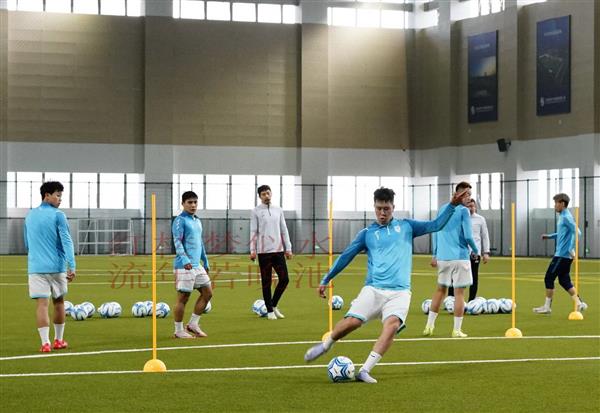

Doubts abound. Takeshi Okada's tacit cooperation with Zhejiang is well known, and Ning Fangze passed the trial, but never managed to debut in the game, why is that? Is the J3 League really so strong that even a Chinese player with a full range of skills can't get a foothold? What was the point of signing the contract in the first place? Is the so-called "cooperation result" just for the sake of having a result?
This incident is reminiscent of Wei Shihao. The internet is abuzz with rumors that he has a strained relationship with his coach, but I don't think the problem lies primarily with the player or the coach. If Wei Shihao is not utilized in the 18-team tournament, the consequences are unimaginable and the management will be under great pressure.
How to phrase this? Ning Fangze may not fully understand it, but we can get a glimpse of it from Imabari FC's evaluation of him. He's a similar type of winger to Chen Binbin and Wei Shihao, both of whom have outstanding speed and strong edge-breaking ability.
Wei Shihao and Ivan "contradiction" according to a blogger analysis, mainly from the lack of defense. Even during the Top 12, he and the "iron guide" also because of the defense problem disagreement. Chen Binbin looks robust, but the defense ability is limited.
The "story" that fans have been talking about happened in the sixth round of the 2020 season in Suzhou, where Seaport beat Guoan 2-1. Chen Binbin played as the left wingback, and the left side of the defense was broken by Wang Gang. Before the end of the first half, Lecco had to adjust the lineup by switching right wingback Wang Shenchao to the left side. After that, Chen Binbin gradually lost Lecco's trust and faded out of the starting lineup.
Chen Binbin's achievements in the league and the national team are obviously not comparable to Wei Shihao's. But Wei Shihao is also a type of winger. If Xu Zhengyuan used a three center back formation in Chengdu Rongcheng, Wei Shihao would also struggle to play as a left wing back. In fact, except for a few players, almost all local wingers, including Chen Binbin and Wei Shihao, have difficulty adapting to other positions.
What does this tell us? Without getting into the level and quality of youth training, I think the most crucial point is: the choice of coaches.
Take Harbor for example. In the late stage of Pereira's coaching, although the three center backs and four backs formations used could be switched flexibly, Chen Binbin still had room to play under the U23 policy at the time, especially as a left winger in the 4231 formation. However, after Leko adjusted his formation to a predominantly 352, Chen Binbin lost his position. Even veteran Lu Wenjun was transformed into a left wingback, and Leko was reluctant to let Chen Binbin play again.
Similarly, whether with his former Guangzhou side (Evergrande), Wuhan Sanzhen or Chengdu Rongcheng, Wei Shihao played mainly as a winger and occasionally as a striker. However, during Janko's tenure, the national football team's formation gradually became fixed to three center backs. Due to the fierce competition on the left wing, Wei Shihao was once moved to the front position. To the Ivan coaching period, the national football team's formation has become a 442 diamond midfield, Wei Shihao almost into the "disappeared" state.
After Li Yuan was suspended for a red card and received an additional penalty, in the match against South Korea, surprisingly Ivan started Gao Tianyi as a left winger, but was forced to change in less than half an hour. "The decision to change the lineup in 28 minutes instantly became a hot topic of discussion. Luckily, the excellent performance of Baihe Lamu appeared to "save the scene", otherwise Ivan may be greatly criticized after the game. This incident has strengthened his tactical philosophy, while Wei Shihao was completely ignored.
Obviously, what Ivan needs is a kind of wingback who can both attack and defend. Except for the away match against South Korea, when the pressure was too much and the midfield position had to be adjusted to "parallel", the rest of the three matches always keep the "diamond" formation unchanged.
In fact, the core issue I want to express is that the soccer management should formulate a systematic plan for the professional league, or at least have a guideline. This is actually to continue the implementation of the "big national team program" proposed by Lippi. At the same time, when choosing a national team manager, it is necessary to focus on whether his soccer philosophy and coaching style are in line with this plan and guideline.
Otherwise, today playing three defenders, and tomorrow become 442 diamond midfield, fans are difficult to accept, the players' ability to adapt will also be affected, the results are naturally unsatisfactory. In fact, except for Shenhua this season, the 442 diamond midfield formation in the Chinese Super League has not appeared for many years. Wei Shihao may not have even seen a team using this formation when he entered the Chinese Super League, let alone playing as a wingback in this formation himself.
The same height of about 1.7 meters tall Kukui health care Ying, although the body is not strong and slow, but the recent news shows that he will be 65 million euros in transfer fees and 15 million euros in annual wages to join Liverpool, to replace the possible departure of Salah in the summer transfer window. Wei Shihao, Lin Liangming and others were forced to give way to the "fast", "strong against" Li Yuanyi, Gao Tianyi and other defensive origin of the midfielders; as for Huang Zichang, since Lippi coaching has been neglected by four consecutive national football bosses.
The low level of youth training, coupled with the lack of a unified style between the leagues, has led to the lack of a clear tactical system for national teams, which has become the biggest weakness and fatal wound of Chinese soccer. As for the selection of the manager, some fans believe that this behavior is like the blind men feeling an elephant, lacking an overall sense of direction.